Nakamoto is selling for less than its Bitcoin. At ~0.96× mNAV, you’re buying the BTC and getting the strategy for free: structured leverage to amplify upside, cross-border treasury deals, and optionality to buy cash-generating Bitcoin related assets that feed the treasury. This is balance-sheet value with operating upside. The setup is simple: execute, accumulate, and let sentiment follow.
Trading below Bitcoin Value
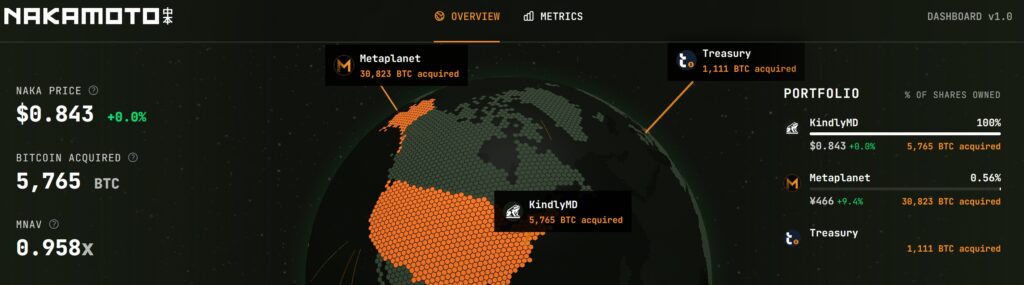
Starting with what’s on hand: Nakamoto holds about 5,744 BTC acquired for roughly $679 million at an average purchase price near $118,204 per BTC. The company went public on Nasdaq in August 2025 via its merger with KindlyMD. David Bailey is CEO, Kevin Zhang runs Asia, and Tyler Evans serves as CIO. The stated mission is unambiguous: push toward one million BTC while building and buying Bitcoin-native businesses that make the treasury more productive. None of that ambition is priced in at 0.96 mNAV. Sub-parity says the market is valuing the equity at less than the worth of the Bitcoin itself, effectively assigning zero or negative value to the strategy.
From mania to discount
The stock has fallen 97% from a May 2025 high of $28.50 to roughly $0.84 in October, and the mNAV multiple that once lived in the double digits has slipped under 1.00. This was not just one name imploding. A meaningful slice of the Bitcoin-treasury cohort has rolled over to asset-value levels as investors moved from paying premiums for growth to demanding proof. The tone of the conversation online has been predictably harsh.
“72 cents. If I worked for Nakamoto I would never show my face in public again,” one critic posted. Another put it bluntly: “Once these things flip under 1 mNAV… what’s the point when you can just own real BTC?”
That kind of sentiment often marks the point where math quietly takes over from emotion.
Leverage that helps, not harms
Nakamoto’s financing choices matter because they speak directly to BTC per share. The company lined up a five-year $250 million convertible with Antalpha, currently documented as a non-binding LOI, and used a $203 million BTC-secured facility from Two Prime as an interim bridge. The intention is simple: extend liabilities, avoid forced selling, and increase BTC per share while growing the balance sheet.
With fixed liabilities and no margin calls, upside in the Bitcoin price flows through to equity with extra force. Keep the multiple at 1.00 and move Bitcoin up 50%; equity can move roughly two turns because debt stays fixed while assets rise. You do not need financial engineering to see it. You just need duration-matched liabilities and discipline on issuance.
That discipline is the other half. At 0.96 mNAV, issuing common share is destructive. The company’s operating rule set is what you would expect from a treasury built to compound: keep the ATM shut below 1 mNAV, use converts and term credit, and run a modest, hedged yield sleeve on part of the holdings so interest expense does not chew through everything in a flat market. None of this is exotic. It is balance-sheet housekeeping that keeps BTC per share moving the right way.
Turning market structure into fuel
Nakamoto is not a passive balance sheet. The core strategy is to invest in other Bitcoin treasuries and Bitcoin-native vehicles in key markets, let local public investors assign a premium to those listings, and then recycle a portion of that appreciated equity back into more BTC or into new targets.
The first moves are already visible. In the Netherlands, Nakamoto backed Treasury, which has accumulated roughly 1,000 BTC and is pursuing an Euronext listing through a reverse merger. In Germany, the company is supporting a first-of-its-kind Bitcoin-treasury initiative through UTXO. The aim is one compliant treasury per major jurisdiction. The effect, if it scales, is a flywheel: originate, list, let the local multiple do the heavy lifting, recycle, and repeat.
Real operating options, not just promises
There is also genuine operating optionality attached to the equity. Nakamoto holds an option to acquire BTC Inc., the parent of Bitcoin Magazine and The Bitcoin Conference, provided BTC Inc. first acquires UTXO Management. If that sequence completes, Nakamoto would add Bitcoin-linked media and events plus an investing arm under one umbrella. With Tyler Evans, formerly of UTXO, already installed as CIO, the integration map is short. Media and events can throw off cash when the cycle turns. An in-house investing platform can source and underwrite deals across the treasury landscape. Both line up with the mandate to turn the balance sheet into a compounding engine rather than a static vault.
What critics miss
It is true that the market has been flooded with new tickers, that PIPE fatigue set in, and that governance questions hover whenever related parties appear. It is also true that these names trade like closed-end funds at times, with premiums and discounts that look more like sentiment than spreadsheets. But none of that erases the basic mispricing when a company with live leverage, a functioning allocator program, and options on operating cash flow sits under 1.00 mNAV.
The online commentary reflects the mood swing.
“Premium and discount dynamics are pure sentiment thermometers,” one market watcher wrote. Another, more constructive line, points to how seeding new treasuries in markets that re-rate faster can create real compounding for the parent. “If a 2× firm seeds a 6× up-and-comer, capital compounds.”
Those mechanics are exactly what Nakamoto is trying to harness.
The math that closes the gap
Undervaluation is not a slogan. It is arithmetic. At 0.96 mNAV, investors are paying less than the value of the Bitcoin on the balance sheet. Any execution that increases BTC per share reduces the need for the market to re-rate to deliver acceptable returns. Closing the Antalpha convertible on the outlined terms would add a meaningful block of BTC and stabilize the liability side for five years. Pro forma, holdings could step toward 7,813 BTC if the additional 2,048 BTC land as planned. Keep mNAV at 1.00 in that scenario and lift Bitcoin by 50%: the equity sensitivity is roughly two times because liabilities stay where they are while assets climb. If, on top of that, sentiment swings from discount to a modest premium, the same balance sheet delivers more again.
There is another lens that value buyers use here: how many months of disciplined accumulation it would take to “cover” the current market cap with additional BTC at today’s multiple. Companies that can close that gap quickly tend to draw patient capital first, momentum capital later. Nakamoto screens well because it can add exposure through structure and investing, not just through the share printer.
What needs to happen next
Three simple things would force the market to take another look. First, close the Antalpha financing on clear terms and spell out the covenant picture so everyone understands that this is long-duration, no-margin credit that matches the asset. Second, show one or two clean international treasury listings with visible trading liquidity, starting with the Netherlands. Third, clarify the path and timing for the BTC Inc. and UTXO option, including how the combined platform would report and how cash flows would be directed toward BTC per share. A fourth, standing rule would help too: formalize that no ATM issuance occurs below a set mNAV threshold and publish the buyback and liability-management playbook for sub-parity periods. That sort of policy has a way of compressing discounts on its own.
Why “undervalued” is the right word
Today’s price gives no credit for the company’s financing progress, no credit for the unique allocator strategy that is already in motion, and no credit for the option to buy Bitcoin-native cash flow. Instead, the market is pricing the equity at less than the value of the Bitcoin itself.
If Nakamoto does nothing but keep BTC per share climbing and stops selling stock below parity, the gap should narrow on arithmetic alone. If it also proves out the international listings and makes the BTC Inc. and UTXO option real, then the case shifts from “should close the gap” to “should command a premium.”
Signal Take
Nakamoto at roughly 0.96 mNAV is the rare combination of discount and design. The balance sheet already carries the right kind of leverage. The capital plan favors long-dated credit and converts over dilution. The investment program turns public-market structure into a source of new BTC per share, and the operating options through Bitcoin Magazine, The Bitcoin Conference, and UTXO give the company a way to fund the flywheel when the cycle turns.
Bitcoin is the monetary base here, BTC per share is the score, and execution is the switch. Close the financing, publish the discipline, stand up the next two treasuries, and the word “undervalued” will look like a temporary label rather than a permanent identity.