
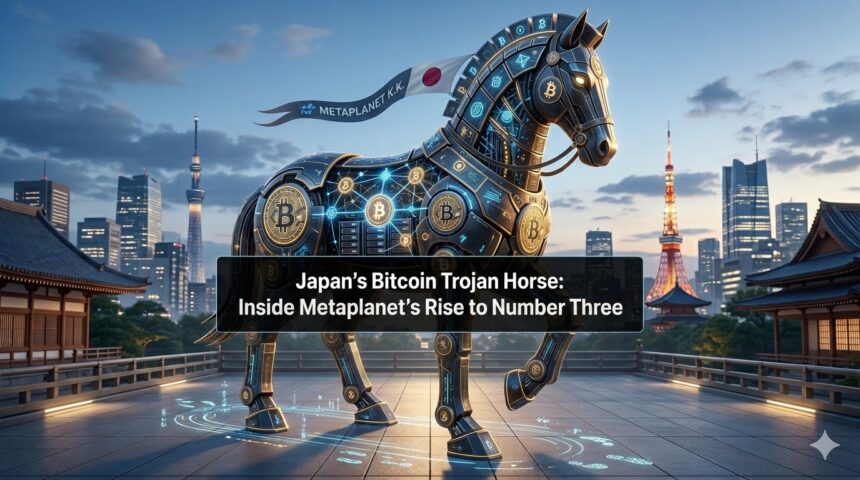
Metaplanet has quietly become the third-largest publicly traded Bitcoin holder on the planet. The Tokyo-listed company closed Q1 2026 with 40,177 BTC on its balance sheet, leapfrogging MARA Holdings and planting a Japanese flag in territory previously dominated entirely by American firms. But the headline number only tells half the story. Behind the stack sits an increasingly ambitious play to build Japan’s entire Bitcoin infrastructure layer from the ground up.
The Climb to Number Three
Metaplanet acquired 5,075 BTC during Q1 2026 for approximately $405 million, buying at a weighted average price of roughly $79,898 per coin. The purchases were made during a period of significant market fear, with Bitcoin pulling back sharply in a quarter that saw its most severe drawdown since 2018. While others were selling, Metaplanet was buying.
The ranking shift was made possible in part by MARA Holdings offloading 15,133 BTC (roughly $1.1 billion) throughout March as the miner pivoted toward AI infrastructure and debt restructuring. That sell-off opened the door, and Metaplanet walked through it. The company now trails only Strategy (approximately 767,000 BTC) and Twenty One Capital (43,514 BTC) among public companies worldwide.
This marks the first time a non-American entity has broken into the top three corporate Bitcoin holders. For a company that began its Bitcoin journey in April 2024 with a ¥1 billion allocation, the speed of ascent has been remarkable.
Project Nova: Building Japan’s Bitcoin Infrastructure
What separates Metaplanet from the growing crowd of treasury companies is what CEO Simon Gerovich is building around the stack. In March 2026, the company launched Project Nova, an initiative designed to become the gateway to Bitcoin in Japan. At its center sits a new wholly owned subsidiary, Metaplanet Ventures K.K., tasked with deploying approximately ¥4 billion ($27 million) over two to three years into regulated Bitcoin financial infrastructure across the country.
The venture arm targets seed through growth-stage companies spanning lending, collateral management, payments, Lightning Network infrastructure, custody, compliance tooling, derivatives, and tokenization. Alongside the investment arm, Metaplanet is running an incubator for early-stage digital asset infrastructure startups and a grants program for open-source Bitcoin developers and educators, with a Japan-first focus and selective global reach.
This is not a company content to simply hold Bitcoin and wait. Metaplanet is positioning itself as the connective tissue of an entire national ecosystem, one that currently lacks the institutional infrastructure that the U.S. and Europe have spent years developing.
The JPX Standoff
Not everyone in Tokyo is cheering. Japan Exchange Group (JPX) recently opened a public consultation on proposed guidelines that would exclude companies holding more than 50% of their assets in cryptocurrencies from the TOPIX index. The next scheduled rebalancing in October 2026 could directly block Metaplanet’s index inclusion, a significant blow for a company with more than 216,000 shareholders.
Gerovich’s response was measured but firm. Rather than fighting the consultation, he acknowledged the process and engaged directly, while pointing to Project Nova and Metaplanet’s expanding operational footprint as evidence that the company is more than a passive holder. The subtext was clear: Metaplanet intends to make itself too integral to Japan’s digital asset future to simply be excluded from an index.
The regulatory tension is worth watching. If JPX follows through, it would create a precedent that penalizes Bitcoin-forward public companies in one of the world’s largest equity markets. If Metaplanet’s diversification strategy convinces regulators otherwise, it could open the door for more Japanese firms to follow the treasury playbook.
A Shareholder Army
One of the most underappreciated aspects of Metaplanet’s story is its shareholder base. The company now counts more than 216,000 individual shareholders, a figure that dwarfs most companies of its size on the Tokyo Stock Exchange. This is not a stock quietly held by a handful of institutions. It has become a grassroots vehicle for Japanese retail investors who want exposure to Bitcoin through a regulated, domestically listed equity.
That shareholder count is also a political asset. Any JPX decision to exclude Metaplanet would affect hundreds of thousands of Japanese investors, a consideration that likely weighs on regulators as the consultation process continues. Gerovich appears to understand this dynamic well, frequently communicating directly with shareholders through social media and public disclosures.
The 555 Million Plan
Metaplanet’s ambitions extend well beyond the current milestone. Under its “555 Million Plan,” the company targets 100,000 BTC by the end of 2026 and 210,000 BTC (roughly 1% of Bitcoin’s total supply) by the end of 2027. Reaching the 2026 target would require acquiring nearly 60,000 additional BTC over the remaining three quarters, a pace that demands continued aggressive capital deployment.
Funding comes from a combination of equity raises, debt management, and a growing Bitcoin income-generation business, primarily options trading against existing holdings, which produced approximately ¥2.97 billion in revenue during Q1 2026. This operational income stream distinguishes Metaplanet from pure-play treasury companies that rely entirely on capital markets to fund acquisitions.
Signal Take
Metaplanet is no longer just a Bitcoin treasury company. It is building the institutional plumbing for Bitcoin adoption across Japan’s financial system. The combination of a massive and growing BTC stack, a venture arm funding infrastructure development, an options income business, and a quarter-million-strong shareholder base creates a flywheel that is fundamentally different from the “buy and hold” model that defines most of its peers.
The JPX consultation is the biggest near-term risk, and the outcome will signal whether Japan’s financial establishment is willing to accommodate Bitcoin-native public companies or push them to the margins. Either way, Metaplanet has made itself impossible to ignore. In a quarter where many treasury companies were forced to sell, Tokyo’s most ambitious Bitcoin firm was buying, building, and climbing. Number three today. The question is how far the ladder extends.