

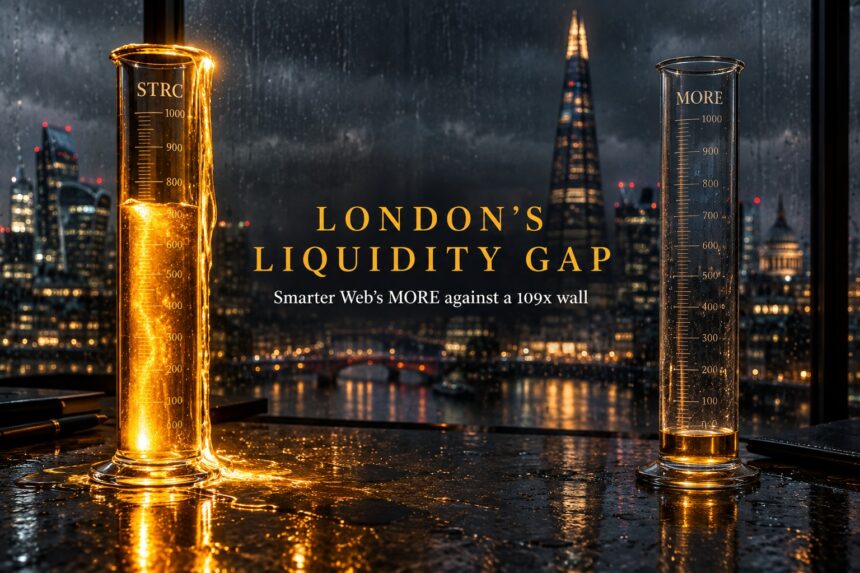
One London listing, three tickers. Together they still trade a fraction of what a single US preferred does in a week.
Smarter Web wants to launch MORE, the first sterling bitcoin-backed preferred on the LSE Main Market. Shareholders vote on 28 September.
Then Brian Brookshire ran the numbers on what London actually trades. Over five sessions, Strategy’s STRC preferred alone turned over 109 times the value of Smarter Web’s entire common equity. Strive’s SATA did 47 times.
That is not SWC against one US preferred. That is SWC across all three of its listings against one.
Brian Brookshire (@btc_overflow)
Brookshire is not writing the company off. “I don’t mean to pick on $SWC here, I hope its upcoming pref program is successful,” he wrote.
His point is about the market, not the issuer. “The challenge in scaling a BTCTC pref in a non-US market is much greater than people realize,” he added.
Liquidity is what makes a preferred work. It lets a fund buy a large block without moving the price, and it lets market makers quote tight spreads.
Thin books do the opposite: wide spreads, nervous buyers, and a yield that has to be higher to make up for both.
MORE has to clear that bar from a standing start. The listing needs at least three market makers signed up, and at least half the preferred shares in public hands.
The FCA has to approve the prospectus before any of that matters.
For scale, SWC’s on-book turnover in London on 18 September was £475,309. That is the base MORE is building on.
Chief executive Andrew Webley is selling the first-mover story. He expects the shares to be “the first of their kind in the UK”.
First in a market that barely trades the common stock is a thinner prize than first in one that does.
Signal Take
Being first is not the hard part. Strategy did not build STRC’s depth by listing it; it built it with years of US institutional flow that London has never had for this asset.
Smarter Web is not trying to match that. It is trying to clear a much lower bar: three market makers, half the stock in public hands, enough demand to get the deal away.
The next move is the 28 September vote, then the prospectus. Whether MORE trades at all is a question for the weeks after that, and the answer sets the ceiling for every UK treasury company that follows.