
For a Bitcoin treasury company, the test is simple: does BTC per share rise over time. The 1920s trusts were built to harvest premiums and leverage a hot equities market; today’s Bitcoin treasuries are accumulating a finite monetary asset — similar mechanics but very different foundations.
The Investment Trust Craze of the 1920s
During the 1920s, closed-end trusts proliferated on U.S. stock markets. They would issue common shares, preferred equity, and debt, then deploy capital into equities and, frequently, into other trusts. Market demand drove their shares to trade at large premiums over their net-asset value (NAV). In many cases, these trusts operated with layers of leverage, sometimes stacking on other trusts in pyramidal structures. When the 1929 crash came, the leverage, premium dependence, and interlocking structures accelerated the collapse.
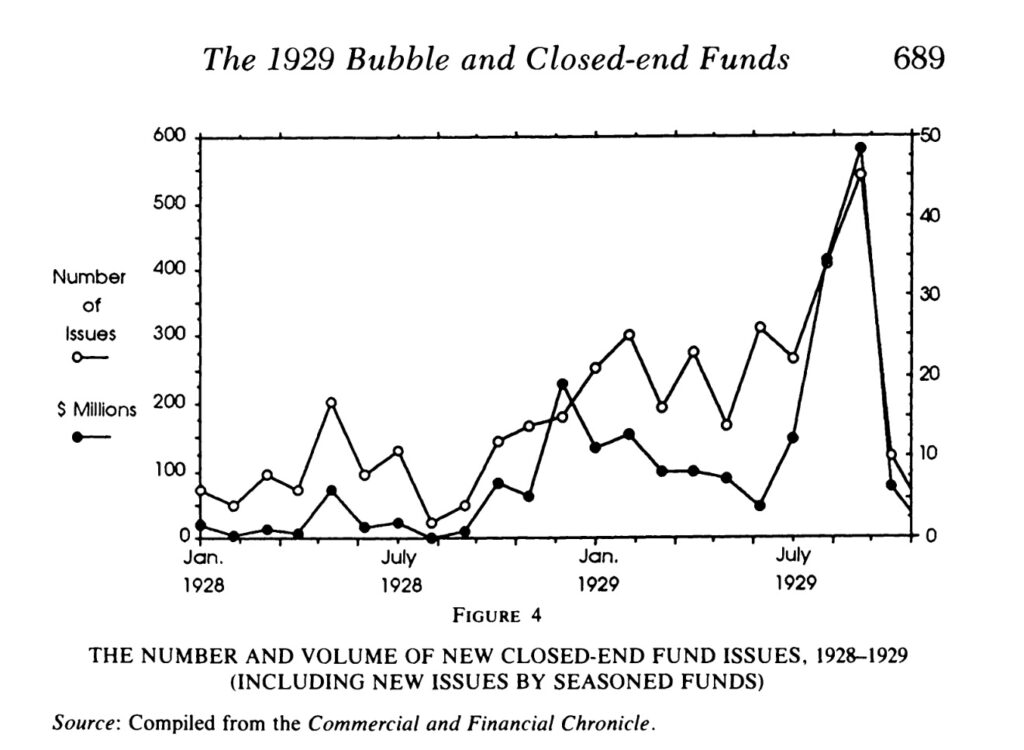
One retrospective study of closed-end investment trusts notes that “the premium itself became the product” — meaning that issuing new shares at a premium became a self-reinforcing mechanism of expansion, rather than a disciplined investment strategy.
Where the Analogy Is Valid
On paper, Bitcoin treasury companies echo that same lever: they may issue equity when their market multiple (the share price relative to imputed BTC NAV) is above 1.00, and deploy proceeds into more Bitcoin. This is mathematically identical to a closed-end trust issuing at a premium.
Some issuers do pause issuance when their market price nears parity. For instance, Metaplanet temporarily suspended the exercise of certain warrants when the share price approached parity with their BTC backing — a tactical move to avoid dilution when premium compression tightened.
Thus, these vehicles can act like premium-driven issuers, where the timing and discipline of issuance becomes central to performance.
Key Divergences: Leverage, Asset Type, and Control
Leverage is Limited Today
Unlike many 1920s trusts built with 2× or 3× leverage (or worse in stacked structures), Bitcoin treasuries so far lean heavily on equity issuance with minimal debt. Even among the more aggressive names, debt or convertible issuance is generally a modest share of BTC NAV — rarely exceeding 20%. Most treasuries use no leverage at all. This difference introduces much less systemic fragility.
Different Asset Class
The 1920s trusts were buying equities valued on earnings, growth, and multiple expansion — often in frothy sectors. Bitcoin treasuries, by contrast, buy BTC: a non-yielding, limited-supply digital asset whose value proposition lies in monetary scarcity and adoption rather than earnings expectation. Whether or not investors agree with that thesis, it is categorically distinct from levering into richly priced equities.
Operational & Audit Risk
One structural nuance absent in the 1920s analog is custody, reserve proof, and audit of BTC holdings. Transparent wallet disclosure, auditor verification, and credible proof-of-reserves are emerging standards. Absent those, investor confidence in a treasury’s balance sheet can be more brittle than trust share pricing in 1929.
The Signal Take
The 1920s trusts lived on leverage and premiums; when the premium died, so did the model. Bitcoin treasuries start from the opposite end — they hold the hardest asset and build yield around it. The premium is just one tool. The more advanced treasuries now issue preferreds, convertibles, or structured notes that settle in Bitcoin. Some sell puts or covered calls on their own stack, turning dormant balance sheets into BTC-generating engines.
Yes, there’s fiat leverage — but it’s backed by an asset with a structural CAGR of 20–40% and a terminal supply of 21 million. The trusts of 1929 borrowed to chase yield in paper. Bitcoin treasuries borrow to accumulate the base layer of a new system. One ended in liquidation; the other is just beginning to compound.