


For the world’s flagship Bitcoin treasury, every financing move is a signal. This week, Strategy (MSTR) signaled a deliberate rotation—away from its common-stock ATM and deeper into preferred issuance. The effect: modest Bitcoin accumulation, but proof that the company can still generate Bitcoin yield even when its mNAV multiple is compressed. Strategy also introduced two new metrics—Leverage and Amplification—revealing how its balance sheet magnifies Bitcoin exposure.
Preferreds Take the Stage
Strategy disclosed roughly $18 million in Bitcoin purchases for the week—small by its own historical cadence, but sourced entirely from preferred stock proceeds rather than common equity. The company raised $10 million via STRF, $5 million via STRK, and $3 million via STRD—three preferred tranches that now form the backbone of its current financing stack. No new common-stock ATM sales were recorded, extending a several-week streak of zero issuance. The message is clear: they want to lever up their balance sheet and amplify Bitcoin returns.
Trading volumes in the preferreds—particularly STRC, Strategy’s largest active series—have accelerated into mid-October. Yet issuance has paused. With STRC still priced below $99 and bound by internal covenants limiting sales below par, the company has effectively locked the tap until the issue trades back into its $99–$101 band. Mid-month also brought the ex-dividend date, generating heavy volume as holders repositioned to capture yield.
Capital Discipline in a Downcycle
The preference for non-dilutive financing fits a broader thesis: preserve bitcoin per share exposure while maintaining the capacity to lever higher once sentiment turns. Market watchers expect a return to the ATM once the premium widens and liquidity stabilizes.
Until then, the preferred program provides a controlled path for incremental stacking increasing BTC/share.
Leverage and Amplification
A new detail quietly appeared on Strategy’s investor homepage this week: Leverage and Amplification. Two numbers—simple on their face, but conceptually defining.
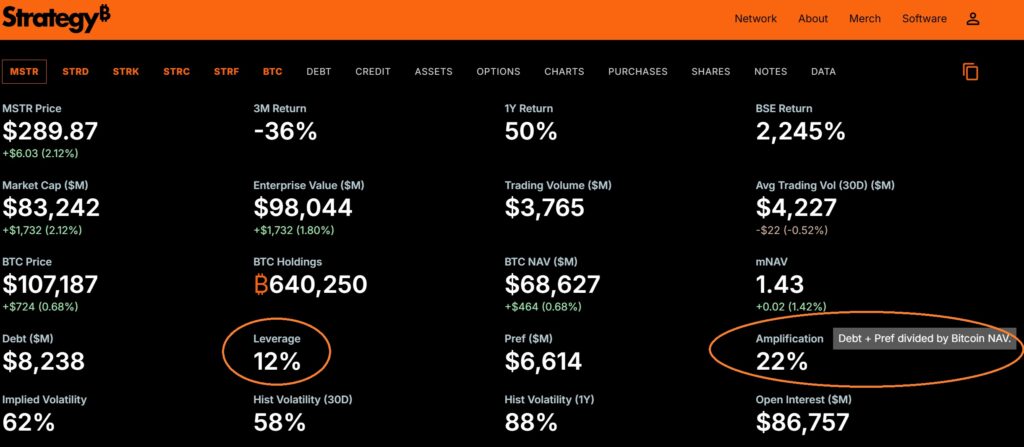
Leverage captures the straightforward measure of borrowed money. Amplification goes deeper—it quantifies how much the company’s exposure to Bitcoin is enhanced by its entire financing architecture: convertibles, preferreds, and structured debt.
At roughly 22%, Strategy’s amplification level is surprisingly conservative. For comparison, conventional corporates—retail chains, airlines, or logistics firms—often operate with 300–400% debt-to-asset ratios.
Imagine the treasury as a sound system. Leverage is the volume knob—how much risk you push through pure debt. Amplification is the amplifier circuit—the full design of instruments that boost the Bitcoin signal all the way to the equity output. Leverage is what they owe. Amplification is what they’ve engineered. – Adam Livingston (@AdamBLiv), a capital-markets analyst focused on Bitcoin treasuries.
It’s a subtle but powerful new metric, one that could become central to how Bitcoin treasuries communicate risk, exposure, and yield as preferred instruments rise to prominence.
Signal Take
Strategy’s latest week wasn’t about size; it was about signal. By pausing common-stock issuance and relying entirely on preferreds, the company reinforced its core identity as a disciplined accumulator.
And now, with amplification as a disclosed metric, investors can see the full architecture behind that discipline—the measured torque between leverage, exposure, and Bitcoin per share.
In a market where most treasuries trade below mNAV and liquidity is scarce, Strategy continues to operate from a position of structural advantage: premium equity, active preferreds, and a balance sheet to generate BTC yield during any period in the market cycle.