On Strategy’s live-streamed Q3 earnings call watched by ~25,000, the message was clear: Saylor and his team is laser-focused on issuing perpetual, public digital credit, taking the preferreds overseas in local currencies, and putting a fresh S&P rating to work with mandate-bound buyers. The outcome: more BTC per share and amplified Bitcoin exposure for shareholders.
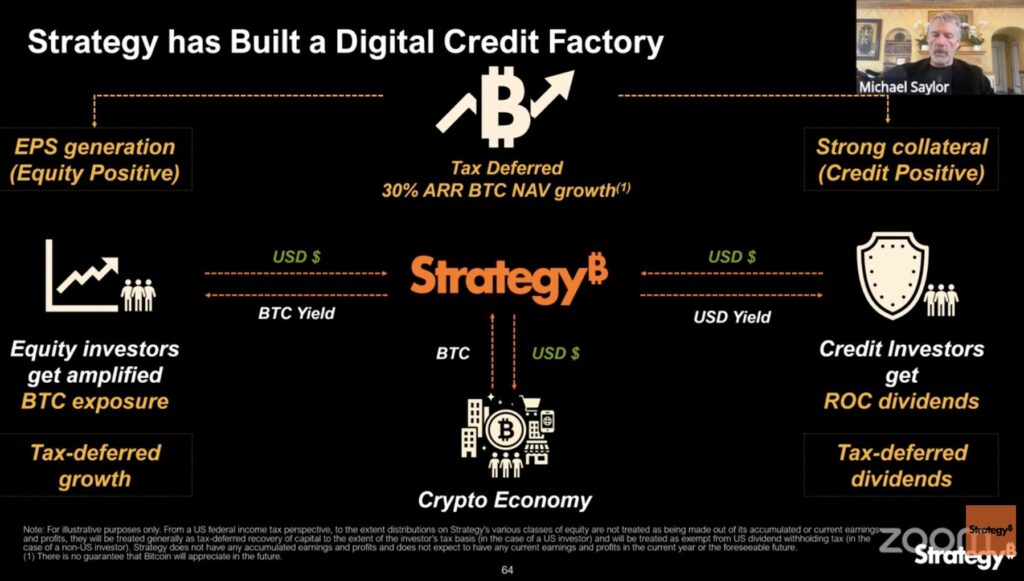
Management presented the four listed perpetual preferreds—STRF, STRK, STRD, STRC—as an assembly line that converts BTC volatility into investor-friendly cash flows while preserving upside where it belongs. The point isn’t packaging; it’s throughput.
As @BitMasterK put it: “Digital credit OBLITERATES conventional credit.” Those proceeds settle into BTC on the balance sheet, and the common captures the reflex.
Amplification Is the Outcome
Amplification rose into the narrative not as a KPI to game but as the byproduct of structure. With converts slated to equitize over the next several years and preferreds scaling, Strategy’s BTC per share accretion reflects how well the factory runs, not how loudly it markets the metric. The target is simple: reduce recourse debt, expand perpetual, non-recourse capital, and let the equity’s performance tell the story.
When market conditions are favorable, issue Bitcoin-backed digital credit to accelerate growth to 40–50% annually… still without adding leverage or credit risk. — @HodlMaryland
STRC Sets the Reference Rate
STRC is now the front door. Dividend steps to 10.5% effective November 1 with monthly pay, seasoning on retail rails (Robinhood, Schwab), and access via major wealth channels. The internal goal is explicit: make STRC the number treasurers compare to money funds.
As @mikewmunz noted, ROC treatment means “the dividends are not taxed… converts any future sale into capital gains,” which is why the product reads less like a niche preferred and more like a treasury sleeve.
All Strategy’s preferreds carry Return of Capital treatment for the “foreseeable future,” deferring taxes by lowering basis instead of generating current income. Combined with interim IRS guidance keeping unrealized BTC gains out of CAMT, the path is clear for mandate-bound buyers to model after-tax yield without contortions.
Rating Secured, Expanding Overseas
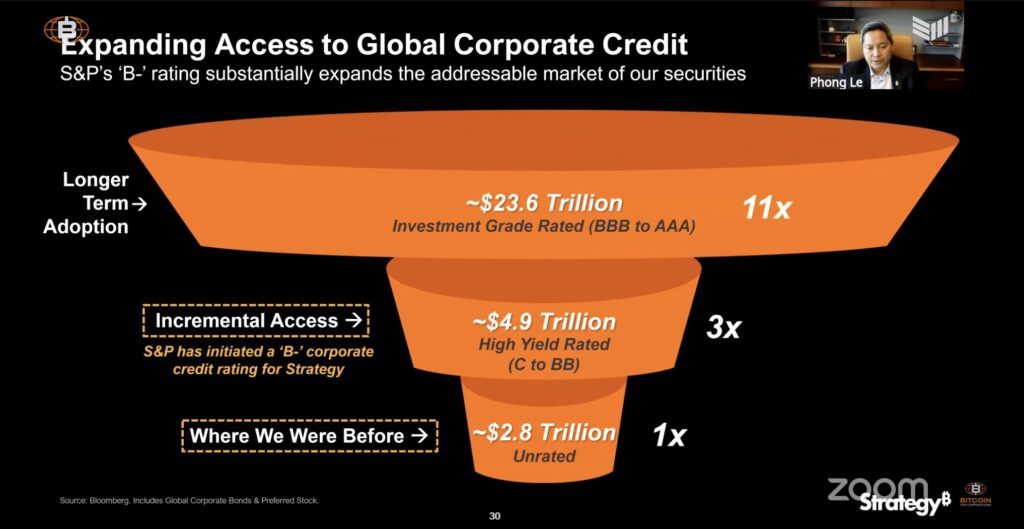
S&P’s B– issuer rating isn’t a victory lap; it’s an access pass. It moves Strategy from “interesting” to “eligible” for insurers, pensions, and yield platforms that require a rating. Management emphasized the longer-term project—getting legacy frameworks to treat BTC as capital—but the practical effect now is more compliant demand for the preferred stack.
The next wave is native-currency issuance abroad. Expect CAD in Canada, EUR in Europe, and other markets where local investors want yield without FX drag. The spread math is compelling outside the U.S., and the playbook is consistent: perpetual public credit that maps cleanly into local distribution.
Signal Take
Strategy is no longer a story about “owning Bitcoin.” It’s operating a factory that manufactures USD yield from digital capital and recycles it into more BTC per share. The innovation is not the balance sheet; it’s the funding rails: perpetual, public, rated, tax-advantaged digital credit that broadens the buyer base and lowers the cost of capital without adding default risk. The result? Amplified Bitcoin for shareholders, a no-brainer for the die-hard Bitcoin maximalist.