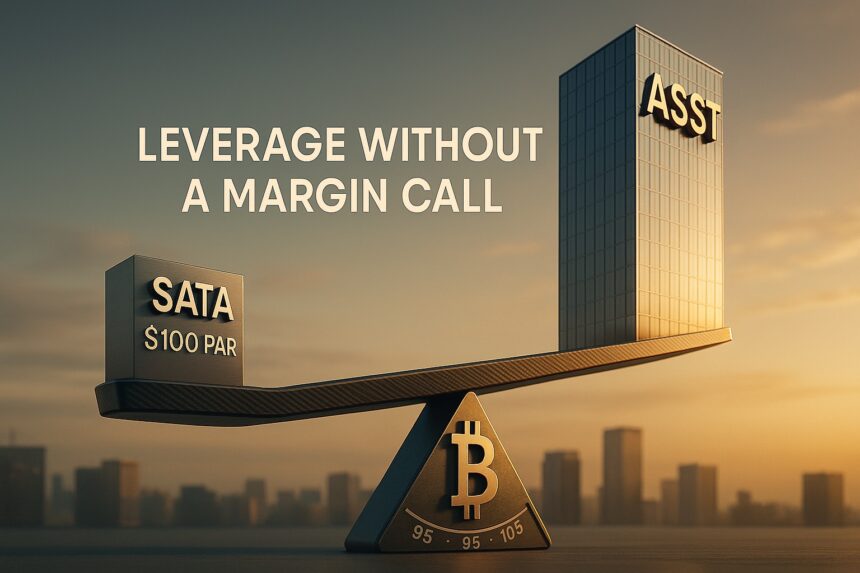
Bitcoin treasuries are stepping into digital credit, and Strive showed the blueprint in public. SATA, a perpetual preferred priced at $80 (currently already trading at $90) on a $100 stated amount and upsized to $200 million, converts balance-sheet BTC into stable, high-yield credit while leaving upside with common. On The Hurdle Rate (ep. 35), the team walked through why that matters for ASST: equity-only amplification, ROC dividends, and a clear plan to keep the preferred near par.
Leverage without a margin call
Strive is running the simple stack: ASST (amplified Bitcoin) and SATA (Bitcoin-powered yield). No debt. No margin. No encumbered BTC. That matters because BTC compounds; SATA’s obligation does not. If long-run BTC returns exceed the dividend, the spread accrues to common. The preferred supplies the leverage without introducing maturity or refinance risk.
Yield that manages to par
SATA’s dividend is 12% of the $100 stated amount. At the $80 IPO print, that was ~15% effective yield. Management expects return-of-capital treatment, which improves after-tax outcomes for many holders. The operating guide is explicit: a $95–$105 target band around par, a floor at 1-month SOFR, cumulative accrual with step-ups if payments are paused, and a call at $110. If SATA trades below the band, issuance shuts off and the rate can step up. Above, issuance resumes and the rate can come down. A 12-month cash reserve for dividends was set aside at launch to backstop the program.
Demand in a choppy BTC week
Books filled at the top of talk and the deal hit the max upsize while BTC bounced around ~$100k. That’s the tell: buyers are underwriting the credit profile, not the daily print. Peer liquidity reinforced the point and retail came through via major broker channels. The market’s message was straightforward—stable, senior yield backed by unencumbered BTC is a product that many portfolios want.
Coverage that stacks quickly
Post-deal, Strive reported 7,525 BTC. With ~$200 million of SATA outstanding, that’s ~3.8x BTC coverage and roughly 32.7x annual dividend coverage at ~$101k BTC. A ~3.5% move higher in BTC would add about one year of dividend coverage in unrealized balance-sheet gain. Duration stays low versus typical bond funds while yield sits well above money markets, and ROC treatment widens the after-tax gap.
Why this amplifies ASST
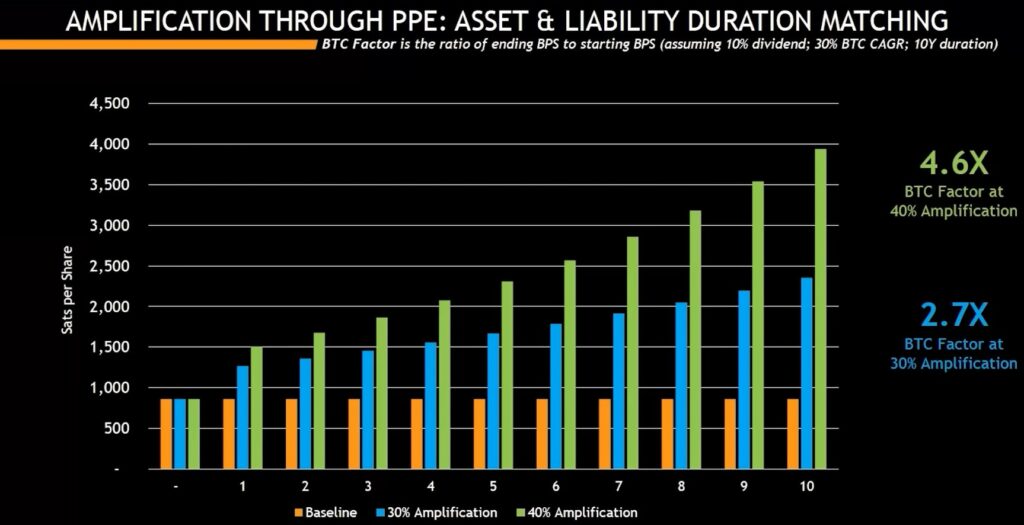
This is a carry trade built for a Bitcoin treasury. Keep the preferred near par, let the asset base grow, and common captures the spread over the dividend. On the show which you can watch below, the team framed 30–40% long-run BTC CAGRs as the working range many investors model. With 25–40% equity-only amplification and a ~10–12% dividend, BTC per share can climb meaningfully over a decade, independent of any common ATM usage.
SATA monetizes part of the BTC stack into predictable cash flows without risking forced sales. Par management turns the dividend knob to hold price stability. When it trades rich, Strive can issue preferred via ATM to add BTC and keep the amplification ratio intact, helping ASST’s BTC/share grind higher without touching common.
The next levers
Three near-term drivers line up as credit enhancers: a large block of warrants that can bring in cash for more BTC, the Semler transaction with >5,000 BTC potential, and incremental SATA issuance to hold amplification steady as assets scale. Management also said SATA will be the only preferred for at least 12 months. Fewer products, deeper liquidity.
Signal Take
SATA is the operating bridge between volatile reserve and stable yield. It’s perpetual, non-recourse, and designed to be managed in the open market. Keep the dividend funded, keep issuance disciplined, keep BTC unencumbered, and the carry does the work. If Strive sticks to that playbook, ASST’s BTC per share should compound through the cycle because of digital credit, not despite it.