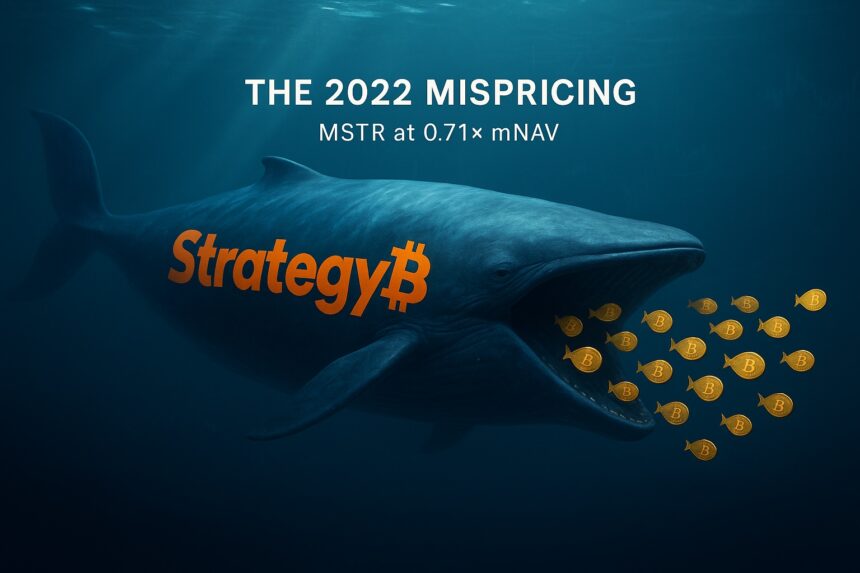
Three and a half years ago Strategy’s (MSTR) traded to a fully diluted mNAV of 0.71 on May 12, 2022. The market was capitulating, Bitcoin hovered near $28,000, and bearish narratives were loud. The strategy, however, was intact: use low-cost liabilities to create torque to Bitcoin’s long-term compounding.
Buying amplified Bitcoin at a discount
MSTR trading below it’s Bitcoin holdings is more than a bruised chart; it changes the math for prospective holders. At ~0.71× mNAV, investors were effectively buying each share’s embedded Bitcoin below spot and receiving embedded leverage that did not require personal margin.
“You were effectively buying Bitcoin at a discount and gaining access to relatively cheap leverage,” Joe Burnett notes.
From that trough, MSTR rallied more than 2,000% into early 2024, a move that reflected both Bitcoin’s recovery and the convexity created when fixed liabilities meet a rising monetary base.
Intelligent leverage in practice
Nothing about the corporate doctrine shifted at the lows. MSTR continued applying what Michael Saylor has called “intelligent leverage”—borrowing at a cost below Bitcoin’s expected long-term CAGR to amplify returns. In this construct, the balance sheet is a transmission mechanism. When liabilities are duration-matched and priced sensibly, upside in BTC accrues to equity with extra force because the debt stays fixed while the asset base scales.
Sentiment whiplash vs. arithmetic
The 2022 setup was clouded by noise: online fixation on a miscalculated “liquidation price,” breathless headlines, and the fatigue that trails multi-month drawdowns. Volatility plays with emotions and can distort how people feel about their investment thesis. The lesson was not philosophical; it was mechanical. Discounts to mNAV close when treasuries either retire shares below 1 mNAV or when Bitcoin’s path higher forces a re-rate. Premiums reappear when market demand returns for equity that delivers more BTC per share per dollar than a spot buy.
Today’s read-through for Bitcoin treasuries
Market demand for amplified Bitcoin has fallen not because of the fundamentals of Bitcoin. Nothing has changed: a fixed schedule of issuance, censorship resistance, and a monetary policy that is predictable far beyond any equity cycle. What has changed is the appetite to pay for amplification. That creates a familiar spread across the cohort of Bitcoin treasuries: some names near or below 1.0× mNAV, others nursing compressed premiums after an issuance-heavy year.
The CAGR test
The decision rule is straightforward. If an investor’s forward view of Bitcoin’s compound growth rate clears the all-in cost of amplification, leverage can be accretive to BTC per share through the cycle. If it does not, amplification is a tax, not a tailwind. If you expect a Bitcoin CAGR north of 15% over the next decade, amplified exposure remains compelling. The caveat is real: both Bitcoin and amplified Bitcoin can trade lower first. The presence of drawdown does not invalidate the mechanism; it stresses whether the structure and sizing were built for it.
Discipline matters more than narratives
The market tends to assign large penalties when issuance and leverage outrun demand. It also tends to over-punish when sentiment is thin, pushing mNAV multiples below 1 mNAV even when liability profiles are sound. In both cases, the cure is operational: no new equity issuance below 1.0×, term out liabilities at fixed rates, and publish policies that prioritize BTC per share over headlines. Reflexivity cuts both ways, but discipline compounds.
Signal Take
MSTR’s 2022 case study is a reminder that the spread between price and value in Bitcoin treasuries opens widest when emotions are loudest. At 0.71× mNAV, MSTR offered discounted BTC per share and embedded torque, and the subsequent 20× move validated the structure as the cycle turned. Today’s cohort shows similar fractures in sentiment even as Bitcoin’s base case remains intact. For allocators who still underwrite a long-horizon CAGR that beats the cost of amplification, the work now is the same as it was then: separate narratives from mechanics, measure everything in BTC per share, and let the math close the gap.